When I realized Japanese New Year feels different
I’ve experienced New Year’s celebrations both in Japan and abroad, and because of that, I’ve come to feel just how unique the Japanese New Year really is.
I’ve only celebrated New Year’s Eve outside Japan once.
It was in Spain, spent with Mimi’s friend’s family, and it’s a memory I truly cherish.
While I enjoyed discovering a different culture, I found myself unexpectedly missing the Japanese New Year.
It should have been lively and fun, yet somehow my mind didn’t feel calm.
The reason for that only became clear to me slowly, after I returned to Japan.
What surprises many people about Japanese New Year
Let me start by explaining how New Year is usually spent in Japan.
In Japan, December 31st is called Ōmisoka (New Year’s Eve), and January 1st is Gantan (New Year’s Day).
Around this time, many people return to their hometowns and spend the holiday quietly with their families.
While customs vary slightly by household and region, many families eat osechi ryōri on the night of December 31st.
Osechi is a special New Year’s meal made up of many small dishes, each carrying symbolic meanings such as health, happiness, or prosperity.
On New Year’s Eve in 2024, Mimi and I went back to my hometown in Hokkaido to spend the holidays with my family.
That’s when a small incident happened.
The osechi we had ordered never arrived.
I remember thinking, “How does this happen on such an important day?”
Apparently, the order hadn’t gone through properly.
I was a little stunned, but at the same time, I laughed and thought, This is so typical of my family.
Once they realized what had happened, my mother and aunt immediately started making osechi by hand.
They could have chosen a simpler meal instead, but they didn’t.
That made me realize how seriously they treat this day as something special.
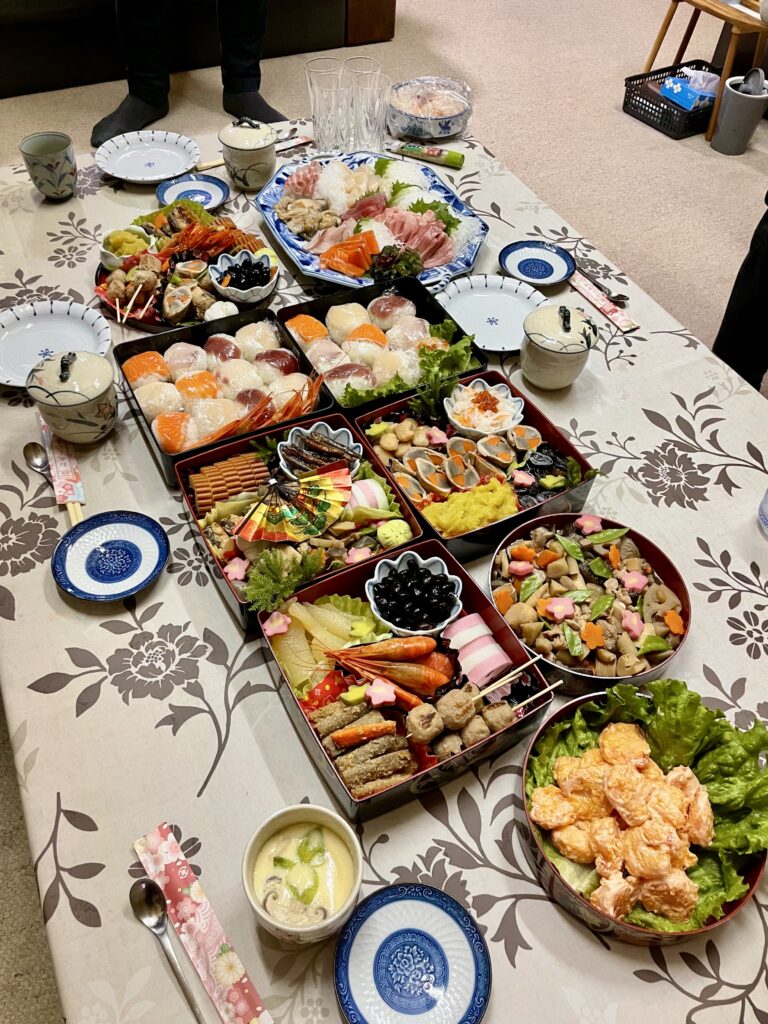
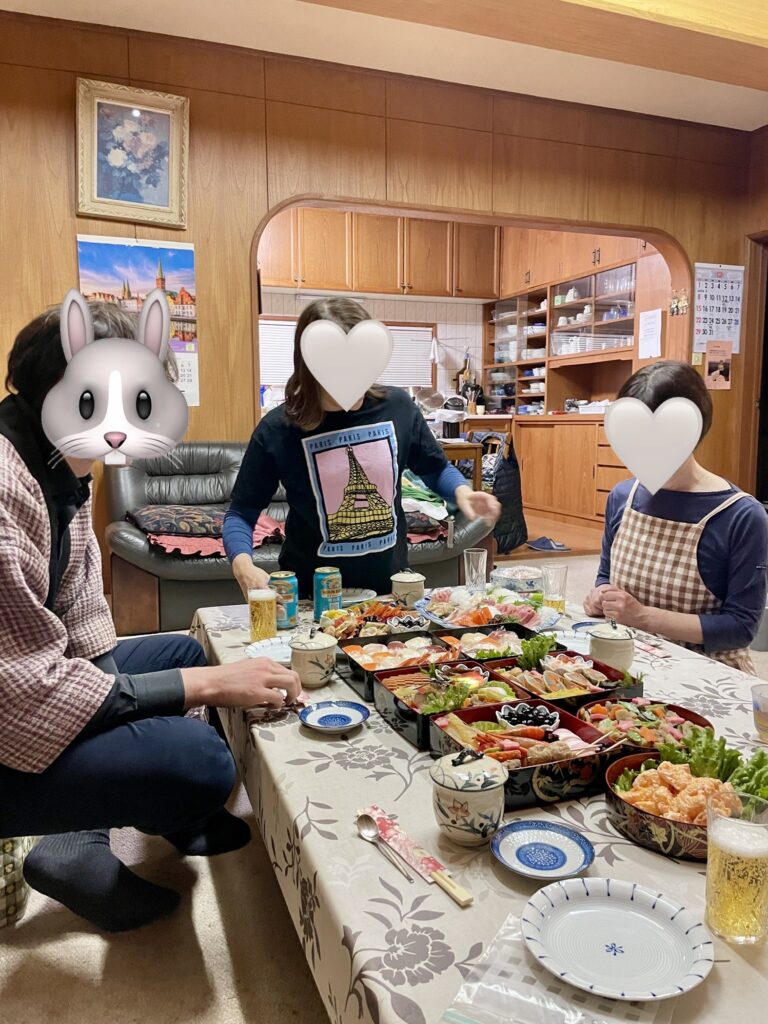
These days, handmade osechi is quite rare.
By the way, most people usually pre-order osechi in advance.
If it’s December 30th or 31st, you can sometimes still find osechi at large supermarkets such as AEON, Ito-Yokado, or Seiyu.
However, they are very popular and often sell out quickly, so it’s best to go early in the morning.
My mother and aunt proudly said it might be their “life’s masterpiece.”
For Mimi—and even for me, who grew up in Japan—it was the first time we had ever seen such an elaborate homemade osechi.
We were both surprised and genuinely moved.
Osechi isn’t something you finish in one night.
Most families eat it over two or three days.
My personal favorite is kuromame—sweet black beans simmered with sugar and soy sauce.
Every New Year, my mother used to make a huge pot of them.
Besides osechi, people also eat foods like toshikoshi soba (buckwheat noodles eaten before the year ends) and ozōni, a traditional soup with rice cakes.
Dinner usually starts around 5 p.m. on New Year’s Eve.
After that, families watch special live music programs on TV or talk together while quietly waiting for midnight.
Japanese New Year is very quiet.
As the year changes, the sound of joya no kane—temple bells rung slowly through the night—fills the air.
When I hear those deep, lingering sounds, it feels as if the events and emotions of the past year are gently being washed away.
And no, there are generally no fireworks.
In Spain, the atmosphere was completely different.
The streets were packed with people, loud music blasted everywhere, lights flashed, and everyone was dancing.
On TV, people ate twelve grapes in time with the bells, opened champagne, hugged each other, and celebrated together.
The joy of welcoming the new year seemed to explode outward.
I once heard that when Mimi’s parents spent their first New Year in Japan, they kept asking, “Where are the fireworks?”
I imagine Japanese New Year must have felt a bit underwhelming to them.
It’s less about celebrating and more about closing the year
Celebrating New Year in Spain was fun, but the Japanese way of welcoming a new year has a different kind of beauty.
By greeting the new year quietly and gently, the feeling that “a new year has begun” slowly sinks in.
In Japan, New Year isn’t so much about excitement or big celebrations.
It may be more like a moment to pause and reset your mind.
I think Japanese people value “closure” because there is a cultural habit of clearly ending the year in visible ways.
For example, many households do a thorough cleaning of the house at the end of December.
It’s not just about tidying up—it’s closer to the idea of properly finishing the year.
People don’t want to carry a year’s worth of exhaustion, regrets, or unresolved feelings into the next one.
That’s why they eat special food, listen to the temple bells, and quietly let the year come to an end.
It feels less like “celebrating” and more like “resetting” or “realigning.”
I usually spend New Year’s Eve at home, but some people go to shrines and welcome the new year there, followed by hatsumōde, the first shrine visit of the year.
It’s cold and crowded, which is why I personally don’t enjoy spending midnight at a shrine—but that’s just my preference.
Hatsumōde doesn’t have to be done on January 1st, either.
I’ll write more about that in another article.
If you want to experience it yourself
If you happen to be in Japan over New Year, staying near a shrine can be a good option
Even though I’m not a big fan of spending New Year’s Eve at a shrine myself, I still think it’s worth experiencing at least once.
It’s a unique atmosphere you can only feel at this time of year.
Learning basic shrine etiquette or how to draw an omikuji fortune can make the experience even more enjoyable.
Also, keep in mind that many restaurants are closed on December 31st.
If you want a proper Japanese meal, booking a hotel or ryokan with dinner included is a safe choice.
Everyone celebrates differently
Japanese New Year traditions aren’t strict rules that must be followed.
It’s perfectly fine to spend it quietly, or even just go to bed early at home.
Rather than thinking, “This is how it should be,”
Japanese New Year is more about choosing how you want to spend it.