When you live in Japan, inexplicable events suddenly begin
In Japan, February 3rd is called Setsubun.
On that day, beans suddenly fly through living rooms, adults turn into demons, and people start eating whole sushi rolls in complete silence.
There is no long explanation. No warning.
It happens every year, as if it were perfectly normal.
And somehow, we accept it without question.
When Japanese people try to explain why Setsubun exists, many of us become vague.
It’s not that we don’t know the origin.
We simply don’t feel the need to put it into words.
“It’s just that kind of day” feels like a good enough answer.
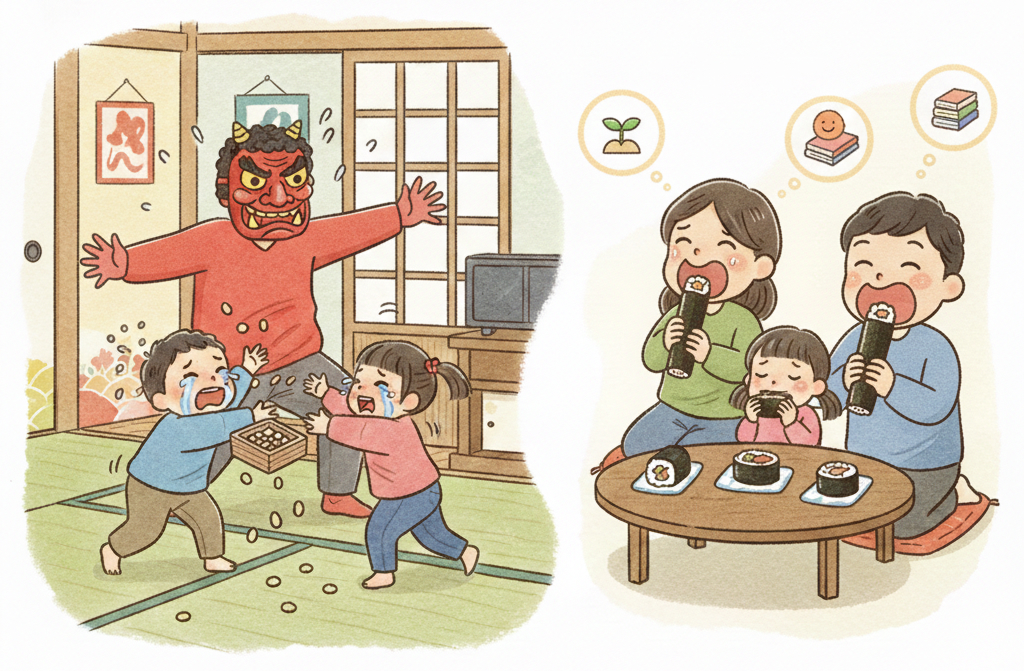
More than “believing,” it’s about “doing it anyway”
Setsubun is said to be a ritual to drive away evil spirits and pray for good health.
But if you ask whether modern Japanese people truly believe in demons or evil spirits, the honest answer is probably no.
Still, Setsubun continues.
Perhaps because in Japan, it has settled into life like a rhythm or a habit—something you do without overthinking.
More of a rite of passage than an event
When people think of Setsubun, they think of throwing beans.
Shouting “Oni wa soto, fuku wa uchi”—“Demons out, fortune in”—we throw beans at the demon.
“Oni out” means driving sickness and disasters (the demons) out of the house.
“Fortune in” means welcoming happiness inside. Or so it’s said.
At home, the father often plays the role of the demon.
Children cry in fear, yet still throw the beans with complete seriousness.
Where I grew up, in Hokkaido, we used peanuts instead of soybeans.
In other regions, soybeans are more common.
Peanuts are easier to clean up, more hygienic, and you can eat them afterward.
But in my house, there was no demon.
My father wasn’t the type to participate in events like this.
So as a child, I walked through the house alone, throwing beans into empty rooms.
Throw, pick them up.
Move to the next room, throw again, pick them up.
“Oni wa soto, fuku wa uchi,”
I said quietly, for no one in particular.
The next morning, as I left for school, I liked seeing a few peanuts still lying on the white snow outside the door.
Sometimes there were bite marks—maybe from a fox or some other animal.
I would think, Someone picked them up, and feel oddly happy.
The mysterious rule of eating beans equal to your age
After throwing beans, there is a rule: you eat as many beans as your age.
When I was a child, I watched my mother eat nearly forty peanuts without stopping.
I still clearly remember the pile of empty shells on her plate.
I remember thinking, How can anyone eat that many?
Is it for health? A test of endurance?
Honestly, I don’t really know.
But that confusion, too, is part of Setsubun.
The day adults seriously do something silly
Setsubun might look like a children’s event.
But in reality, it’s also a day when adults commit wholeheartedly to doing something ridiculous.
They put on demon masks, deliberately scare children, and get pelted with beans.
That said, it’s not a problem if you skip it.
Some families don’t do it at all.
Rather than a tradition you must protect, it’s an event you do if you feel like it, for the sake of enjoying time together.
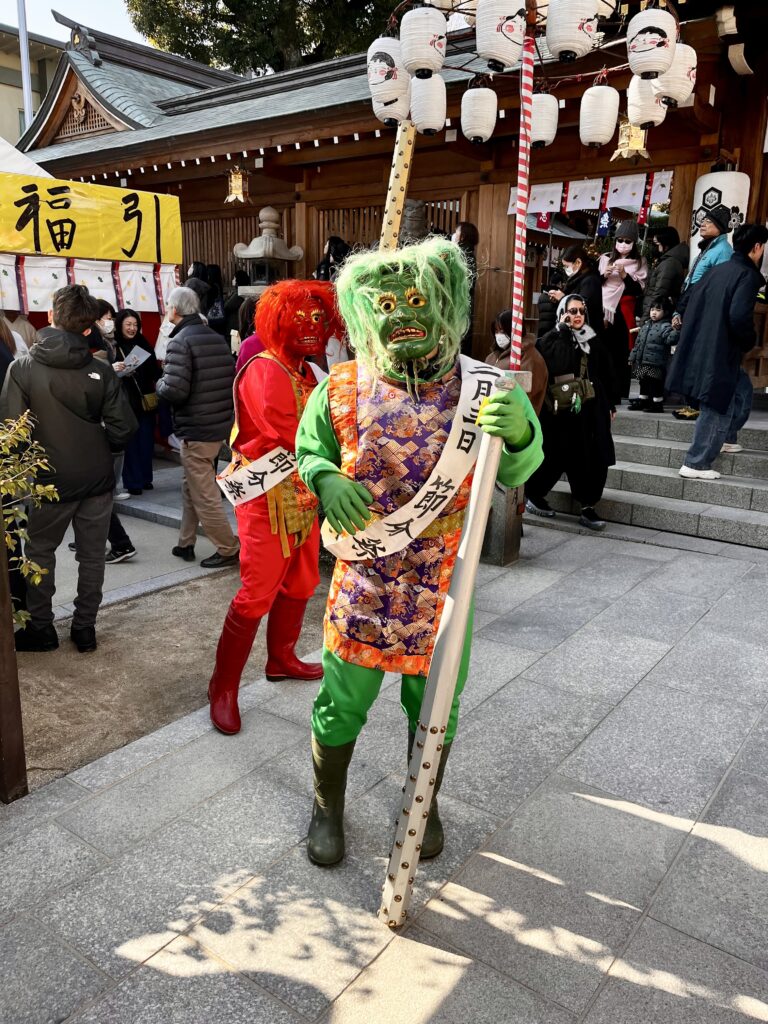
(Location: Kushida Shrine, Fukuoka)
Ehō-maki: the seriousness of doing something absurd
Another essential part of Setsubun is ehō-maki, a thick sushi roll.
You face the year’s lucky direction,
don’t cut the roll,
don’t speak,
and eat the whole thing while silently making a wish.
This year’s direction was south-southeast.
The most important rule is not speaking while you eat.
If you talk, they say, your luck will escape.
Honestly, eating a large sushi roll alone, in complete silence, is not easy.
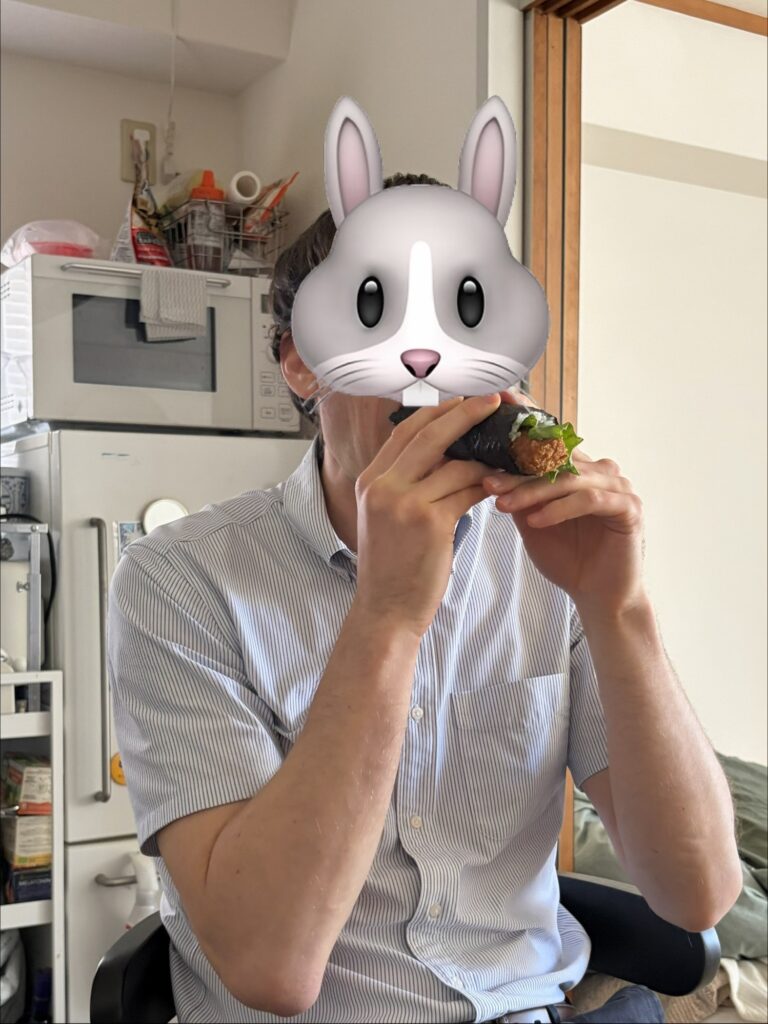
This year, I ate ehō-maki with Mimi.
It was his first time. After hearing the rules, he finished the whole roll without saying a word—then smiled and said,
“That was my first ehō-maki!”
That reaction explained the ritual better than I ever could.
Outside, Setsubun suddenly becomes a “festival”
At shrines and temples, Setsubun becomes much livelier.
On Setsubun day, many shrines and temples hold bean-throwing events.
From a stage, beans and sweets are thrown into the crowd, and people press forward, hands outstretched, trying to catch them.
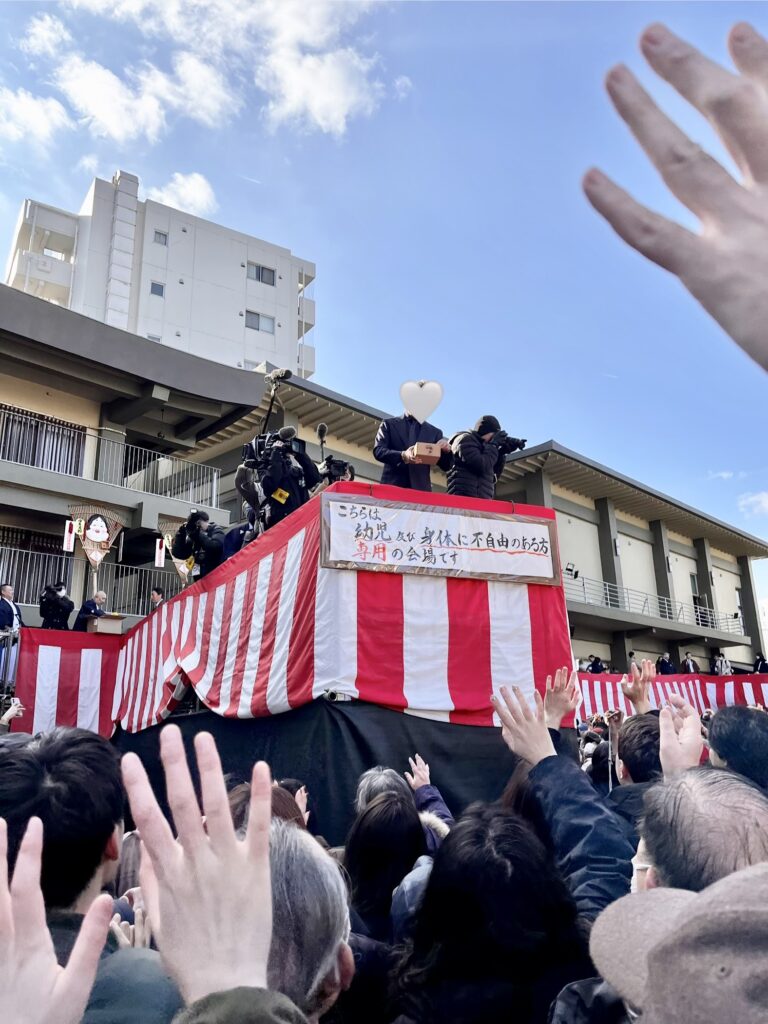
(Location: Kushida Shrine, Fukuoka)
Only a few get to throw the beans—celebrities, or those who signed up in advance.
But anyone can be on the receiving side.
People push forward, stretch out their hands, and wait for beans to fly their way.
The scene is both comical and strangely desperate.
As I keep watching, it starts to look like a scene of people asking for alms.
The distance between those who throw the beans and those who receive them is small.
Yet simply switching roles completely changes how the scene looks.
If you want to experience Setsubun as a visitor
If you happen to be in Japan around this time, you might want to experience Setsubun for yourself.
Take a look at a nearby shrine or temple—there may be a bean-throwing event.
You can also find ehō-maki at supermarkets or convenience stores.
You don’t have to participate. It’s not rude if you don’t.
No one will mind if you skip it.
Just enjoy what you can, in your own way.
After all, in Japan, Setsubun is a tradition we live with at a comfortable distance—
“We don’t fully understand it, but we do it anyway, again this year.”